Quantum Computing In Drug Discovery
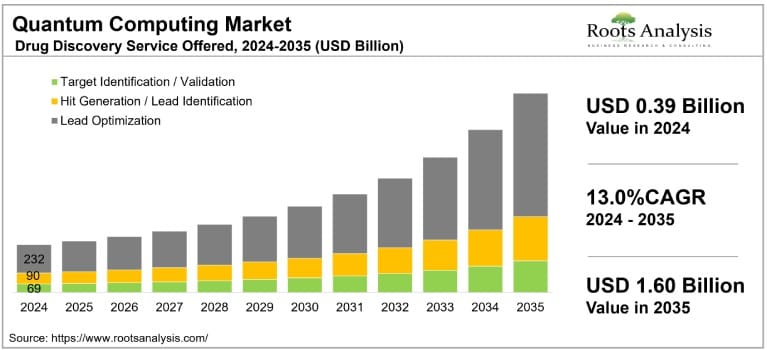
Drug discovery has always been a time-consuming process. On an average, it takes 10-15 years and capital investments worth USD 4-10 billion to commercially launch a drug. It involves various processes such as target identification, validation, hit generation, hit to lead and lead optimization. Whereas development include optimization and formulation, clinical trials and final approval by authorized regulatory. The global quantum computing market size is estimated to grow from USD 0.36 billion in 2023 to USD 1.63 billion by 2035, representing a CAGR of 13% during the forecast period 2023-2035.
However, despite of the advances in technology drug discovery process is still considered to be complex, expensive and lengthy. In order to address such concerns, drug developers are shifting their focus from traditional techniques to the use of novel discovery techniques. Presently, Quantum Computing has emerged as one of the prominent technologies. The use of quantum computing has shown to help the drug developers in selecting potential lead candidates, having the desired physiochemical and pharmacokinetic properties, without having to conduct extensive screening procedures.
Quantum computing is a process, using law of quantum mechanics to solve large and complex problems in short span as compared to the computer aided drug discovery. Currently, there are several quantum computing related approaches that are being used in the drug discovery process alone, such as structure-based drug design, fragment-based drug discovery and ligand-based drug discovery. The predictive power of quantum computing has proven to reduce the complexity, cost and time investment in drug discovery procedure by allowing researchers to bypass the random screening of billions of molecules in a short span of time.
Advantages of Quantum Computing in Drug Discovery:
Faster Computation: It has a potential to perform computation at much higher rate. It is useful in target identification by enabling its deeper exploration of complex therapeutic area
Cost Benefits: It has capability to allow cost effective analysis. It reduces the expensive lab testing by enhancing the screening accuracy of the targeted molecules.
Facilitate the design of Clinical Trials: Quantum computing accelerate the design of clinical trial which. further helps in building virtual patients for clinical trials. This potentially reduces time of trials and increasing quality.
Reduce discovery timeline: It accelerates the high throughput screening of multiple targeted molecules at a given time hence reducing the discovery timeline of drugs.
Possible modeling of complex molecules: It helps molecular modelers to achieve new level of accuracy by modeling complex molecule interaction. It focuses on different target area and increases the affinity towards the targeted molecules.
Hence, it can be concluded that players offering services for quantum computing in drug discovery have now become an integral part of the pharmaceutical industry. Furthermore, considering the various active initiatives being undertaken by players based in this domain, we are led to believe that the opportunity for stakeholders in this niche, upcoming, industry is likely to grow at an exponential pace in the foreseen future.
